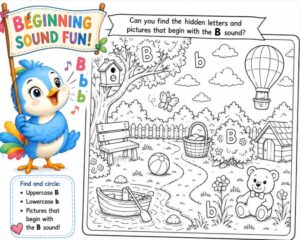
 Learning to hear and identify the first sound in a spoken word is an important phonemic awareness skill and an early building block for learning to read. When children recognize that ball begins with /b/, sun begins with /s/, or fish begins with /f/, they are learning to isolate beginning phonemes—the individual sounds they hear at the start of words.
These Beginning Sound Worksheets take that foundational skill a step further by connecting those sounds to letters. Children begin building letter-sound correspondence, an essential phonics skill that helps them understand that the sounds they hear in spoken words can be represented by written letters.
Instead of simply looking at a row of pictures and matching them to a letter, children explore a fun illustrated scene where the learning is hidden right inside the picture. Their job is to search carefully for objects that begin with the target sound. Somewhere in the scene, the uppercase and lowercase forms of the target letter are hiding too, giving children another little discovery to make.
That means children have to do more than just look. They need to name each object, listen to the word, isolate its beginning sound, and decide whether that sound matches the target. At the same time, searching for the hidden uppercase and lowercase letters reinforces letter recognition and letter-sound connections.
And that’s where a simple hidden-picture hunt becomes a meaningful early literacy practice.
As children search, they’re strengthening phonemic awareness, beginning-sound isolation, letter-sound correspondence, uppercase and lowercase letter recognition, vocabulary, visual discrimination, and attention to detail. The activity encourages children to slow down, listen to the sounds in words, and make thoughtful choices rather than simply completing a traditional matching exercise.
There’s a little problem-solving involved, too. What is this picture? What sound do I hear first? Does it begin with the sound I’m looking for? Where could that hidden letter be? Each discovery gives children another opportunity to listen, think, and make a connection.
These worksheets can fit naturally into phonemic awareness and phonics lessons, literacy centers, morning work, independent practice, small groups, review, or early-finisher time. And because the practice is tucked inside a hidden-picture hunt, learning can feel more like a discovery than an assignment!